Resurfacing means taking the worn finish off the concrete shell and applying a new one. Marbelite is a plaster finish laid about 6 to 8 mm thick, according to Marbelite Pools. Swimming resumes only after the finish maker's start-up period and routine are complete, so the care guide of the installed finish decides.
What does the pool surface do?
The concrete shell holds the water. The surface on top of it is what you touch, and what keeps the shell sealed from the water.
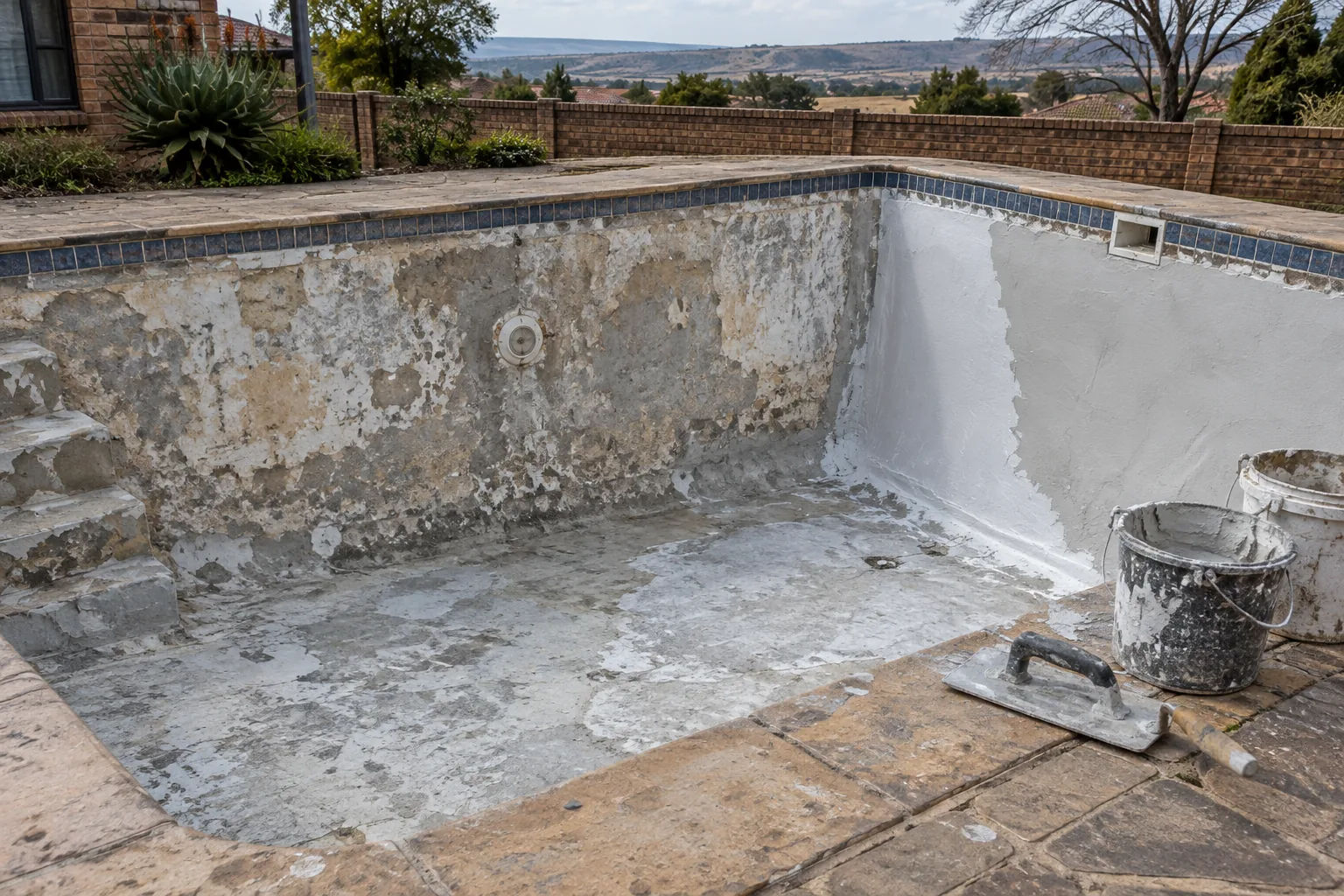
When the finish wears thin, it goes rough, then patchy, then it lets go in places. Resurfacing replaces it across the whole interior, floor and walls, rather than patching one corner at a time.
Crispy Pools, a Centurion operator, prices resurfacing as the full interior at a rate per square metre. In its guide, crack work, remodelling, tiling and equipment are priced separately. That split is worth knowing when you compare quotes.
What is marbelite, and what are the other finishes?
Marbelite is a plaster finish applied by hand over the concrete shell. Marbelite Pools describes it as waterproof and bonded to the concrete, laid about 6 to 8 mm thick. It comes in a set of colours, and its site names charcoal, sky blue, dove grey, white and royal blue among the popular ones.
Fibreglass is the other finish that Gauteng operators quote. It is a glass-fibre reinforced laminate: glass fibre set in resin, finished with a gelcoat. Two Gauteng operators price it higher than marbelite for the same pool. The build-up differs from one system to the next, so ask what is being quoted.
Mosaic bands are glass or ceramic tiles along the waterline. Marbelite Pools says they break the waterline and keep the marbelite under water. More on that on the tiling and coping page.
Ask which finish a quote is for. A line that just says "resurfacing" does not tell you.
Does the pool need resurfacing, or something smaller?
Resurfacing is the right job when the finish is worn across most of the pool: rough underfoot, stained through, flaking in many places.
It is the wrong job when the problem is somewhere else. A leaking shell is the clearest case. Crispy Pools advises locating and fixing the leak before applying a new finish, because a new surface over a leaking pool fails.
Cracks need the same question. Not every crack is cosmetic, and a crack that moves or keeps coming back is something the new finish will not hide. That is why inspection, and leak testing where it is needed, come before the final price. The same checks show whether stripping is needed in the first place.
What order does resurfacing follow?
This is the resurfacing part of the full renovation sequence. Contractors and finish systems differ, so the order can vary.
- Drain. Drainage is planned and controlled by the renovator, never by the homeowner. Before any water goes out, they assess groundwater, whether the shell will hold, and the route the water takes away, because an empty pool can be damaged or lifted by groundwater pressure.
- Strip. The old plaster comes off, back to sound concrete.
- Fix the shell. Hollow patches, chips and cracks are made good.
- Tile and cope. Done ahead of the final plaster coat, so the disruptive edge work cannot damage the new finish. See tiling and coping.
- Apply the finish. The new surface goes on and is left to cure as its maker specifies.
- Reconnect and check. The weir, return and light go back, and plumbing and wiring are checked.
- Fill and start up. See the aftercare below.
One Gauteng operator says a straightforward job is normally out of action for three to five days from drain to refill. That is that operator's construction figure, and it does not tell you when you can swim. A shell that needs crack work will take longer.
What happens after the new surface goes on?
The first weeks decide how the new surface settles. What follows is one finish maker's published guide, Marbelite Pools' care guide. Filling windows, brushing, chemistry and equipment limits depend on the product and system installed, so the written start-up instructions for the installed product control. Where they differ from this list, follow them.
- Filling. Marbelite Pools says to start filling roughly 6 to 72 hours after application, depending on weather. Put the hose at the bottom of the deep end and fill from there. Do not switch the tap off until the water reaches halfway up the border mosaic tile.
- Keep out. Never walk into the pool before it is filled.
- Brushing. Brush daily for the first 14 days with a nylon-bristled pool brush. After that, 2 to 3 times a week.
- Automatic cleaner. Marbelite Pools says not to add one for the first 14 days.
- Heater. Do not use a pool heater until all plaster dust has been removed. The guide says that typically takes 14 to 21 days.
- Cover. No pool cover on the filled pool for 28 days after resurfacing. This is about the pool once it has been resurfaced and filled. It is not about a drained pool, which must never be covered with an ordinary or floating cover.
- Chemicals. The guide says not to use pool chemicals containing copper or metal sulphates.
- Water testing. The guide has you test pH, chlorine and alkalinity daily or every second day during the first 14 days.
Whatever finish goes on your pool, ask for its written start-up instructions before the water goes in.
Chemical safety during the work
Pool chemicals and acid are hazardous. Two rules apply to every renovation.
- Never mix acid and chlorine. The two together release toxic gas. Store them apart, and leave any acid washing and chemical handling to the person doing the work.
- Keep children and pets away. Keep them away from the pool, the work area and every chemical for the whole job, and from the pump room while chemicals are out.
Wet pool edges and bare concrete are slippery. Treat a drained pool as a deep hole. Keep a secure barrier or fence-off around it for as long as it is empty. Never put an ordinary or floating pool cover over a drained pool: it can hide the drop and will not hold a person. The 28-day no-cover rule in the start-up list is separate, because it applies to the filled pool after resurfacing.
Get a price to resurface your pool
Tell us where you are, how big the pool is and what state the surface is in, and we'll phone you to settle a time to look at it.
Sources for the figures on this page
- Marbelite applied 6 to 8 mm thick, waterproof, bonds into the concrete; popular colours; mosaic bands keep marbelite submerged at the waterline (Marbelite Pools, no date, 2026 footer) www.marbelitepools.co.za
- Fill 6 to 72 hours after application, hose in the deep end, tap on until halfway up the border mosaic tile; brush daily for 14 days with a nylon brush, then 2 to 3 times a week; no automatic cleaner for 14 days; no heater until plaster dust is gone (typically 14 to 21 days); no cover for 28 days; no chemicals with copper or metal sulphates; test pH, chlorine and alkalinity daily or every second day for 14 days. This is one finish maker's guide; the written instructions for the installed product control (Marbelite Pools care guide, no revision date, 2026 footer) www.marbelitepools.co.za
- Order of work as one operator lists it, and out of action three to five days from drain to refill (Trademen Pools, undated, 2026 footer). Tile and coping work before the final plaster coat is this site's stated order, and the exact order depends on the contractor and finish system trademenpools.co.za
- Resurfacing priced as full interior per square metre; crack work, remodelling, tiling and equipment priced separately; fix any leak before the new finish; fibreglass priced above marbelite (Crispy Pools, figures compiled October 2026) crispypools.co.za
- Never mix chlorine products with acid; keep children and pets away from chemicals and the area where they are handled; store chemicals apart (US CDC, Pool Chemical Safety poster; US source used only for the basic safety rule) www.cdc.gov